Hip resurfacing is a specialist operation performed by a small number of surgeons worldwide, and patients have been travelling abroad for hip resurfacing for more than two decades. The pattern is consistent: people decide they want resurfacing rather than a total hip replacement, often after being told locally that resurfacing is not offered, and then look for experience rather than convenience. Surgeon volume matters more in resurfacing than in almost any other hip operation, and the research on choosing a hip resurfacing surgeon is blunt about it.
Birmingham is where the modern operation grew up, and Mr Shakir Hussain continues that tradition: he was trained in hip resurfacing by Mr Ronan Treacy, co-designer of the Birmingham Hip Resurfacing, and has performed more than 450 resurfacings across the metal-on-metal Adept and the ceramic ReCerf implant systems. The ceramic bearing is made in sizes down to a 40 mm head, which has reopened the operation to women and smaller-framed patients that most overseas centres still turn away.
UK private care also comes with a regulatory framework international patients can check independently: Mr Hussain is registered with the General Medical Council (GMC number 6135851), his joint replacement activity is recorded in the National Joint Registry, and all three hospitals he operates at are regulated and inspected by the Care Quality Commission.
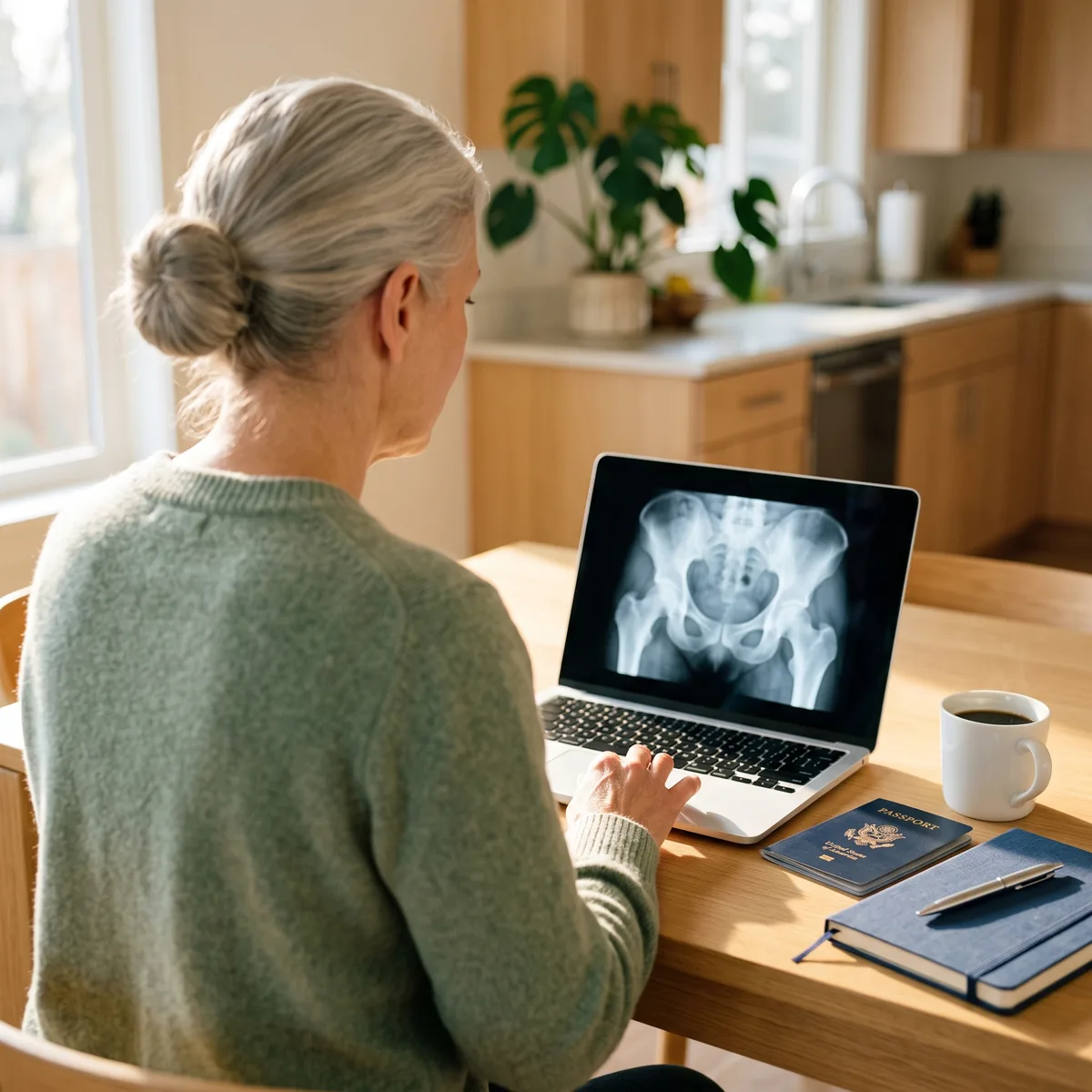
Yes, and this is where every international enquiry should begin. Before you consider travelling for treatment, Mr Hussain will review your X-rays and tell you whether hip resurfacing looks realistic for your hip; the review costs you nothing and commits you to nothing. Suitability for resurfacing rests on bone quality and anatomy, so whether you are a candidate can usually be judged well from good recent imaging, and confirmed in person when you arrive.
The questionnaire asks about your general health as well as your hip, so Mr Hussain can judge fitness for surgery and travel alongside suitability for resurfacing. The remote review is an opinion, not a formal consultation. Your form and images go directly to a secure NHS email account and are used only to advise on your enquiry.
Why this matters If your hip is not suitable for resurfacing, you find out from your home, not after an international journey. Very few patients travel only to be turned away.
Most international patients spend between one and two weeks in the UK, depending on the length of the flight home. The schedule below is the typical shape of a visit; your own dates are agreed with Wendy Richards, Mr Hussain's secretary, before you book travel, and the consultation, pre-operative assessment and surgery are arranged as one coordinated visit.
Your X-rays are reviewed remotely and resurfacing is judged realistic. Dates for consultation and surgery are then held for you, a written quotation is prepared, and the practice provides a confirmation-of-treatment letter with your appointment details to support your travel arrangements.
Birmingham Airport is around half an hour from all three hospitals, and direct trains connect central London to Birmingham in under two hours, so flying into London Heathrow or Gatwick works well too. A concierge pick-up from any of the three airports can be arranged for an additional cost, and arriving a day or two before your consultation gives you time to settle.
Mr Hussain examines your hip, reviews your imaging with you on screen and confirms the plan; up-to-date X-rays can be taken at the hospital on the same day if needed. The pre-operative assessment, including blood tests and anaesthetic review, is arranged around the same visit.
The procedure is usually performed under spinal anaesthesia with sedation, although a general anaesthetic can be chosen if you prefer; hip resurfacing patients tend to be fit and active, so both options are usually open, and the anaesthetist discusses the choice with you beforehand. You take your first steps with the physiotherapist within hours, fully weight bearing from the start. Many patients are ready for discharge within a day, but the package quoted to international patients includes up to three nights in hospital, so you leave when you are ready rather than to a deadline.
You recover at your hotel with short, frequent walks, your exercise programme and scheduled pain relief, with an anticoagulant continuing for several weeks to protect against blood clots. You are shown exactly how to care for the wound before leaving hospital, and it is checked before you fly. The full week-by-week picture is in the recovery guide.
Departure is timed to your journey home: for short-haul flights, around seven days after surgery is usually enough; for long-haul flights, 10 to 12 days is recommended, because longer flights carry a higher clot risk after any hip surgery. Your wound is checked before you fly, any remaining reviews are arranged by video once you are home, and in-flight precautions, regular movement, hydration and compression stockings, are part of your going-home plan.
The numbers to plan around Short-haul patients typically need about a week in the UK after surgery; long-haul patients should plan for 10 to 12 days. Your exact dates are agreed with Wendy before you book anything.
International patients pay the same fixed prices as UK patients, with no surcharge for coming from abroad. Hip resurfacing at Royal Orthopaedic Hospital private care (The Woodlands Suite) is a fixed, all-inclusive self-pay package: £12,250 with the metal-on-metal Adept and £13,450 with the ceramic ReCerf. The package covers Mr Hussain's surgical fee and the anaesthetist's fee, the implant, theatre time, your hospital stay (up to three nights for international patients), in-patient physiotherapy and routine post-operative follow-up. Packages at Priory Hospital Edgbaston and The Harborne Hospital are quoted individually.
The £250 initial consultation is charged separately, and travel, accommodation and any treatment of unrelated conditions are not included. Routine post-operative follow-up is part of the package; only additional consultations beyond the routine schedule are charged, at £175. After your consultation you receive a written, itemised quotation, held for 12 months, so the figure you plan your trip around is the figure you pay. The full breakdown is on the fees page.
If you hold an international health insurance policy, check with your insurer before travelling whether treatment in the UK is covered and what preauthorisation they need; the practice provides the clinical documentation and cost estimates insurers ask for. UK-based policies are covered on the insurance page.
All prices are quoted and paid in pounds sterling (GBP). If you are budgeting in another currency, allow for conversion fees and exchange-rate movements between quotation and payment; an international transfer service such as Wise often offers a better exchange rate than a traditional bank transfer.
Birmingham Airport (BHX) has direct flights from many European cities and connections worldwide, and is around half an hour by taxi from each of the three hospitals. Flying into London Heathrow or Gatwick also works well: direct trains run from central London to Birmingham in under two hours, and the motorway drive takes around two and a half. A concierge pick-up from Birmingham, Heathrow or Gatwick can be arranged for an additional cost; ask Wendy when agreeing your dates. All three hospitals, the Royal Orthopaedic Hospital, Priory Hospital Edgbaston and The Harborne Hospital, are in quiet parts of the city with hotels nearby.
You will need accommodation for one to two weeks, depending on your journey home, apart from your nights in hospital. Birmingham has hotels and serviced apartments at every price point: patients often choose a Premier Inn in the Northfield area, close to the Royal Orthopaedic Hospital, or the Hyatt Regency in the city centre for a full-service stay. A ground-floor room or a hotel with a lift makes the first week easier, and Wendy can advise when you agree your dates.
Many visitors coming to the UK for private treatment travel under the Standard Visitor route; whether you need a visa in advance, or an electronic travel authorisation (ETA) instead, depends on your nationality, so check the current rules on gov.uk. The practice provides a confirmation-of-treatment letter stating your appointment details, the planned treatment and its expected cost and duration, which is the document border and visa authorities expect private patients to carry.
A partner, relative or friend is welcome at your consultation, and having a companion for the first days after surgery makes the early recovery noticeably easier. Since you will spend at most a few nights in hospital, your companion mainly needs a comfortable base nearby rather than anything arranged through the hospital itself.
Follow-up does not stop at the departure gate. Routine post-operative reviews are part of the package, and for international patients they are carried out by video at the usual intervals. X-rays are taken by a radiology provider near you and sent to the practice for review, you take a written physiotherapy plan home with you, and in the early weeks you can reach Wendy and Mr Hussain directly by email or phone with any concern, whatever the time zone.
It is also worth saying plainly what happens if something goes wrong, because serious problems, though uncommon after hip resurfacing, are the question every sensible traveller asks. The complications most likely to need the surgical team, such as wound problems, occur early, while you are still in Birmingham within reach of the hospital that treated you. For the rare problem that arises after you are home, Mr Hussain reviews your imaging remotely, speaks with you by video and coordinates with a local orthopaedic team where hands-on care is needed. This is discussed honestly before surgery, not discovered afterwards.
The longer term Hip resurfacing patients are followed up over the long term wherever they live: periodic X-rays taken locally and reviewed in Birmingham, with a video review when anything needs discussing.
Yes, and it is the recommended first step. Download the short medical questionnaire from this page, fill it in on your phone or computer, and email it with a recent X-ray of your pelvis to Mr Shakir Hussain's secure NHS email address. He will review them and give you an opinion on whether hip resurfacing looks suitable, normally within a few working days; the review costs you nothing and commits you to nothing. No travel is booked, and nothing is committed to, until you know the operation is realistic for your hip.
For short-haul flights, around seven days after surgery is usually enough; for long-haul flights, 10 to 12 days is recommended, because longer flights carry a higher risk of blood clots after surgery. You continue the anticoagulant medication after surgery, simple in-flight precautions such as regular movement and compression stockings are part of the going-home plan, and your wound is checked before you fly.
Many visitors coming to the UK for private medical treatment travel under the Standard Visitor route; whether you need a visa in advance, or an electronic travel authorisation (ETA) instead, depends on your nationality. The practice provides a confirmation-of-treatment letter with your appointment details, the expected cost and the planned length of stay to support your travel arrangements. Check the current requirements for your country on gov.uk before booking.
International patients pay the same fixed self-pay packages as UK patients: £12,250 for Adept metal-on-metal hip resurfacing and £13,450 for ceramic ReCerf hip resurfacing at Royal Orthopaedic Hospital private care. The package covers the surgeon's and anaesthetist's fees, the implant, theatre time, the hospital stay (up to three nights), in-patient physiotherapy and routine follow-up. The £250 initial consultation, travel and accommodation are separate, and a written itemised quotation is issued after your consultation.
Yes, and it is encouraged. A partner, relative or friend is welcome at your consultation, and having someone with you for the first days after surgery makes the early recovery easier. The package includes up to three nights in hospital if needed, and your companion mainly needs accommodation near the hospital, which the secretary can help you plan.
You will be told before you travel, not after. That is the point of the remote X-ray review: if your bone quality or anatomy makes resurfacing unwise, Mr Hussain will say so plainly and explain what he would recommend instead, which for some hips is a total hip replacement. Suitability is always confirmed in person at consultation, but the remote review means very few patients travel only to be turned away.
One email tells you whether the journey is worth planning. Fill in the short medical questionnaire, send it with a recent pelvis X-ray, and Mr Hussain will give you his opinion before you book anything.
Email Your X-rays