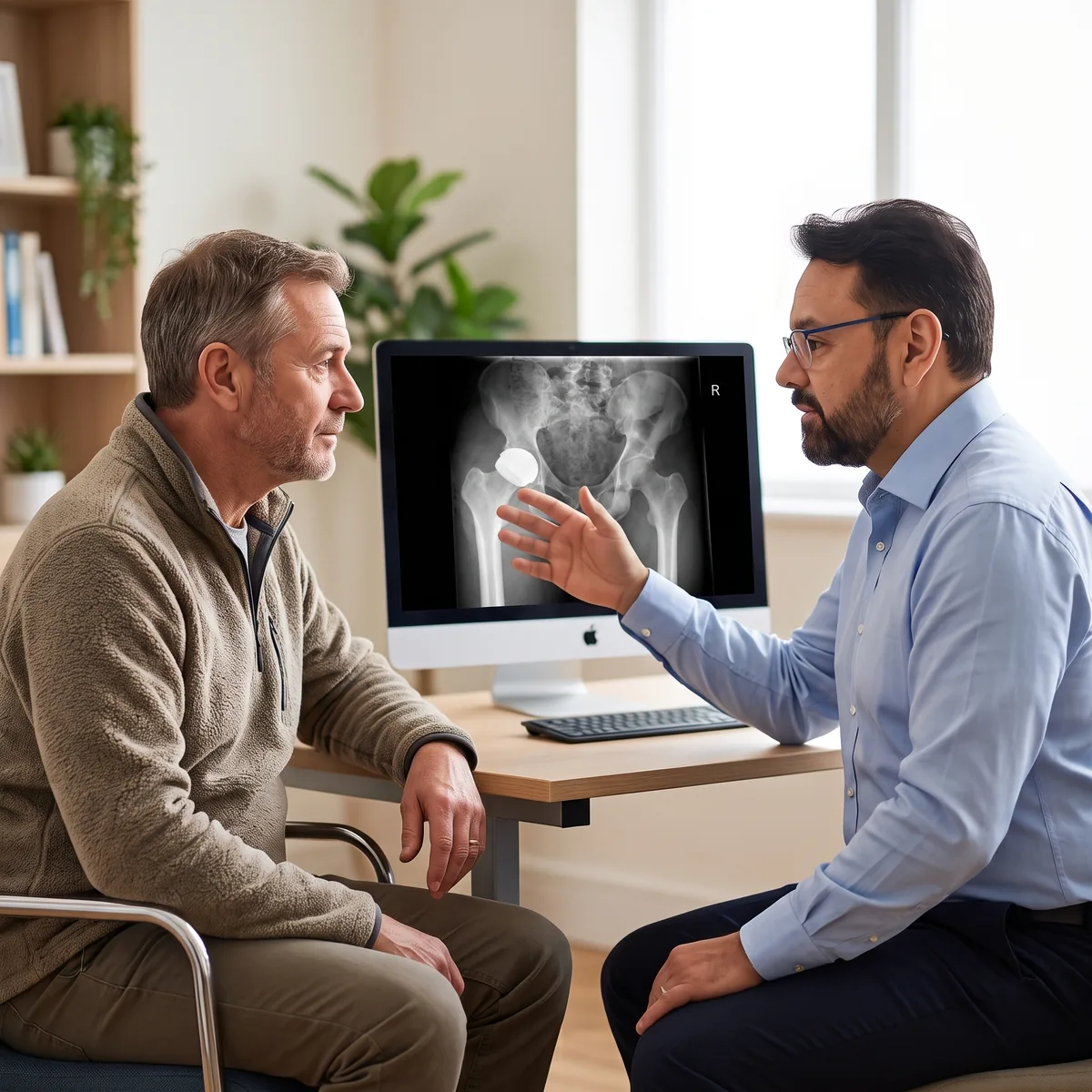
Hip resurfacing is a well-established operation with good long-term results in the right patients, but no surgery is risk-free, and a worthwhile consultation should say so plainly. The risks fall into two groups: the general risks shared by all major hip surgery, and a smaller set of complications specific to resurfacing because the operation keeps the patient's own femoral head and neck.
The encouraging part is that most of these complications are uncommon, and the things that reduce them are well understood: choosing the right patient, choosing the right implant, and operating with a surgeon who performs resurfacing regularly. Where resurfacing differs from a standard replacement, it is sometimes safer (dislocation, for example, is markedly less likely) and sometimes carries a distinct risk, such as fracture of the preserved neck. Both are set out below.
These risks apply to any major hip operation, resurfacing or replacement. They are uncommon, actively guarded against, and most are detected and treated early when they do occur.
Deep infection of a joint replacement is uncommon, on the order of around one per cent, but it is serious when it happens. It is guarded against with sterile theatre discipline, prophylactic antibiotics and careful wound care, and it is one of the reasons any escalating redness, discharge or fever after surgery should be reported promptly.
Deep vein thrombosis, and rarely a pulmonary embolism, can follow any lower-limb surgery. The defence is layered: early mobilisation on the day of surgery, compression stockings, and a course of anticoagulant medication that continues for several weeks after you go home. Walking soon and often is itself one of the best protections.
Injury to the nerves or blood vessels around the hip is rare. Most nerve symptoms that do occur are temporary and settle over weeks to months. Permanent injury is uncommon and is minimised by careful surgical technique and familiarity with the anatomy.
The risks of modern anaesthesia are small and are assessed individually before surgery. A spinal anaesthetic with sedation is often used for resurfacing, which avoids some of the risks of general anaesthesia; your anaesthetist will discuss the safest option for you at the pre-operative assessment.
Because resurfacing preserves the femoral head and neck rather than removing them, it has a distinct risk profile. None of these is common, and each is closely tied to patient selection and surgical experience.
Because the native femoral neck is kept, it remains a potential point of failure. Published series typically report fracture rates between one and two per cent, with the great majority occurring in the first six months while the bone remodels around the implant cap. Good bone quality, careful patient selection, precise technique and a graduated return to impact are the principal defences, which is why bone quality is assessed so carefully before resurfacing is offered.
The blood supply to the femoral head can be disturbed during preparation of the implant. In a small number of patients this leads to death of the bone beneath the cap, with later pain and the possible need for revision. The risk is higher in patients whose bone is already compromised, which is another reason imaging is reviewed closely before surgery.
As with any implant, the bond between the components and the bone can deteriorate over time. Modern fixation has made this uncommon, but it remains the most common long-term reason that any joint replacement, including resurfacing, may eventually need to be revised. If a resurfacing does need revising, it converts to a standard total hip replacement from preserved, near-normal bone.
This is the family of problems, including metallosis and pseudotumour, caused by fine cobalt and chromium debris from a metal-on-metal bearing. It is specific to metal bearings; modern ceramic-on-ceramic resurfacings remove the source entirely. Patients who already have a metal-on-metal hip stay on regular surveillance under MHRA guidance. The full picture is set out in the guide to metallosis.
Because the native neck is preserved, resurfacing offers less scope to adjust leg length and offset than a stemmed replacement. This is rarely a problem in patients with symmetrical anatomy, but it can matter in those with a significant pre-existing leg-length discrepancy, a point weighed up at assessment.
Worth knowing Dislocation, a notable concern after standard hip replacement, is markedly less likely after resurfacing: keeping the large native femoral head (typically 44–56 mm) makes the joint much harder to dislocate. It is one of resurfacing's genuine mechanical advantages.
Almost every complication above is influenced by three decisions made before the operation ever starts. This is why two surgeons can report very different complication rates with the same implant.
Resurfacing works best in patients with good bone and suitable anatomy. Declining patients for whom a replacement is safer is not caution for its own sake; it is the single most effective way to keep fracture, avascular necrosis and loosening rare. Whether resurfacing suits your hip is the subject of the candidacy assessment.
Resurfacing has a steep learning curve. Data from the National Joint Registry link higher surgeon volume to lower revision rates, and peer-reviewed data show complication rates more than three times higher in low-volume hands, with consistent component positioning taking at least 75 dedicated cases to achieve. What to look for is set out in the guide to choosing a hip resurfacing surgeon.
The choice of bearing changes the risk profile directly: a modern ceramic-on-ceramic implant removes the metal-debris risk altogether, while metal-on-metal remains appropriate for a defined group with proper surveillance. Matching the implant to the patient is part of what a specialist does.
The honest way to understand your own risk is to have your hip and imaging assessed individually. That is exactly what a consultation is for.
Book a ConsultationFracture of the preserved femoral neck is the complication most specific to resurfacing. Published series typically report rates between one and two per cent, and the great majority occur within the first six months while the bone remodels around the implant. Careful patient selection, good bone quality, precise surgical technique and a graduated return to impact are the principal defences.
It can, but it is markedly less likely than after a standard total hip replacement. Resurfacing keeps the patient's own large femoral head, typically 44 to 56 mm across, and a larger ball is much harder to dislocate than the smaller head used in most replacements. Dislocation is one of the areas where resurfacing has a genuine mechanical advantage.
Only with metal-on-metal bearings. Adverse reaction to metal debris, the family of problems that includes metallosis and pseudotumour, is specific to metal-on-metal implants. Modern ceramic-on-ceramic resurfacings do not release cobalt or chromium and therefore do not cause it. Patients who already have a metal-on-metal hip remain on regular surveillance under MHRA guidance.
Most resurfacing complications are reduced by the same three things: careful patient selection, an experienced high-volume surgeon, and the right implant for the individual. Registry data link higher surgeon volume to lower revision rates, and peer-reviewed data show complication rates more than three times higher in low-volume hands. Choosing a suitable patient and a suitable bearing does the rest.
General figures only go so far. At consultation, Mr Hussain will review your imaging and tell you plainly what the risks are for your hip, and whether resurfacing is the right operation for you at all.
Book a Consultation