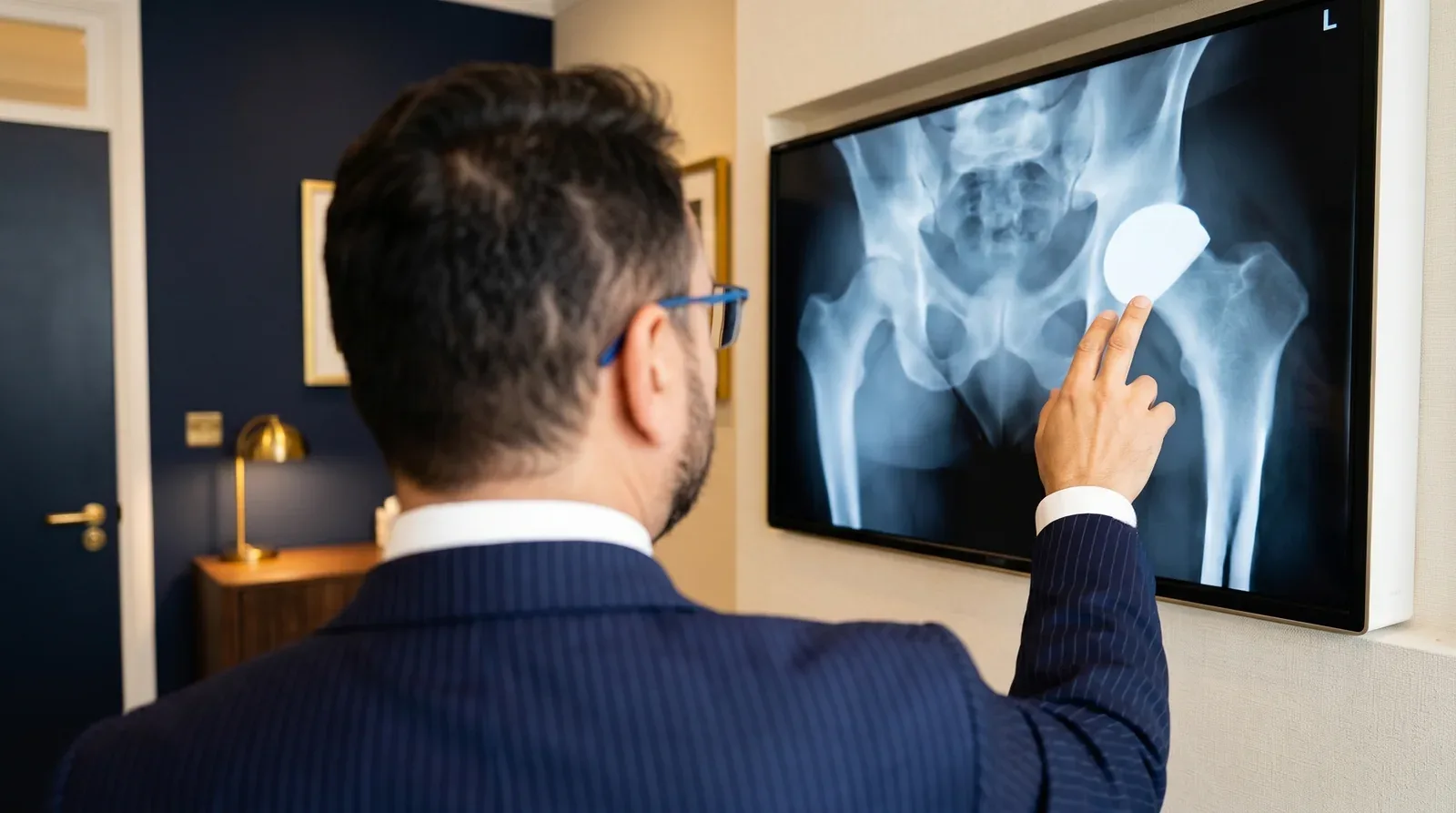
Avascular necrosis, also called osteonecrosis, is death of bone in the femoral head after its blood supply is cut off. The ball of the hip is fed by a small number of vessels running up the neck, and if they fail, a segment of bone dies. Living bone is constantly repaired; dead bone is not, so under the daily load of walking the weakened segment slowly cracks and the round head caves in.
Once the surface has collapsed, the cartilage over it fails and the hip becomes arthritic, often quickly. That is why AVN is one of the commoner reasons for a hip operation in people well under 50: it does not need decades of wear to destroy a joint. It affects both hips in a large proportion of patients, which is why the other hip is always imaged too.
In many patients no cause is ever found. Where there is one, the usual culprits are long-term corticosteroid treatment (for asthma, inflammatory conditions, transplants or cancer), heavy alcohol use, sickle cell disease, a previous hip fracture or dislocation, radiotherapy or chemotherapy, and diving-related decompression illness. The cause matters less for the hip itself than for the rest of the patient: it shapes which implant is safe and whether the other hip is at risk.
Surgeons grade AVN by whether the femoral head has collapsed, and how far. Early disease shows only on MRI, with a normal-looking X-ray and a round head. Intermediate disease shows the first signs of the head flattening. Advanced disease has a collapsed head and a worn socket. The stage, and above all the size of the dead segment, decides which operations are possible.
Yes, in many cases. Resurfacing removes the dead segment of the femoral head and fixes a cap onto the living bone beneath, so it suits AVN whenever enough healthy bone remains to support the cap. Hips where the dead area is very large, or where the head has collapsed extensively and become cystic, are better served by a total hip replacement.
This surprises many patients, because AVN is often described as a reason resurfacing cannot be done. The confusion comes from the size of the lesion. A small or moderate area of dead bone is prepared away when the head is shaped for the cap, exactly as arthritic bone is, and the implant sits on healthy bone. A large lesion leaves too little to build on, and in that hip the cap would be relying on bone that cannot be trusted.
The other reason for the reputation is historical. In the metal-on-metal era, most AVN patients were young men with large heads, who did well, but the fear of the cap loosening or the neck fracturing over dead bone made many surgeons cautious. Twenty years of published follow-up have since shown where the line sits, and it is the size of the lesion, not the diagnosis, that predicts success.
Takeaway AVN is not a barrier to resurfacing. A large, collapsed lesion is. The difference is measured on your MRI, and it is usually clear-cut.
On imaging, and then in theatre. An MRI shows how much of the femoral head is dead and whether the head has collapsed; a plain X-ray shows the state of the joint surface and the socket; and where bone strength is in doubt, a DEXA scan measures it. The final check is made at the operation itself, when the head is prepared and the quality of the bone under the cap can be seen directly.
The single most useful measurement is how much of the weight-bearing part of the head is dead, which surgeons estimate from the MRI as an angle around the head's circumference. In a 202-hip series of resurfacing for AVN, lesions covering more than about 300 degrees of that arc were the strongest predictor of the cap failing; smaller lesions did as well as ordinary arthritis. That threshold is generous: most AVN hips that have reached the point of needing surgery fall below it.
Because the cap is carried by the patient's own bone, the bone around the dead segment must be strong. Long-term steroid use, the condition being treated with steroids, and heavy alcohol use can all thin bone, so this is checked rather than assumed. Significant osteoporosis rules resurfacing out regardless of the diagnosis, because the risk of femoral neck fracture rises.
Every patient consenting to resurfacing for AVN also consents to a total hip replacement, and the appropriate implant is in theatre. If, once the head is prepared, the living bone proves less than the scans suggested, the operation is converted to a replacement rather than fixing a cap onto doubtful bone. In experienced hands this is uncommon, and it is the safety net that makes offering resurfacing for AVN responsible.
The wider assessment, including head size, general health and the questions that decide the bearing, is the same as for any patient and is set out on the candidacy page.
That in well-selected hips it lasts as long as resurfacing for ordinary arthritis. The longest series, 99 resurfacings for osteonecrosis in patients averaging 41 years old, reported 90 per cent of implants still in place at 15 years, with no failures from bearing wear. A 202-hip series with a mean age of 38 found 99 per cent survivorship at ten years with two established designs. Both are set out below.
Amstutz and Le Duff followed 82 patients (99 hips) resurfaced for osteonecrosis for an average of nearly 11 years, with the longest at 18. Survivorship with any revision as the endpoint was 90.3 per cent at 15 years. The six revisions were for loosening of a component; none was for wear. Pain, walking and function scores at final review were above nine out of ten. The authors concluded that patients with advanced osteonecrosis were, in their words, excellent candidates for resurfacing.
A larger multi-implant series followed 166 patients (202 hips), mean age 38, for over ten years. Ten-year survivorship was 99.0 per cent for the two established designs in the series and 82.4 per cent for the ASR, a device withdrawn from the market in 2010 for reasons unrelated to AVN. On multivariate analysis, a necrotic lesion of more than 300 degrees was the strongest predictor of femoral failure, and smaller femoral heads carried additional risk.
A British series of 96 Birmingham Hip Resurfacings performed for avascular necrosis, using a technique designed to protect the remaining blood supply to the head, reported 95.4 per cent survival at a mean of 5.4 years and 98 per cent when only the femoral component was counted. Patients remained active, with a mean UCLA activity score of 6.9.
Worth knowing These are metal-on-metal results, because ceramic resurfacing is too new to have 15-year data. The femoral side of the operation, the part that matters for AVN, is the same: the same preparation of the head and the same reliance on living bone under the cap.
Usually a ceramic one. Patients with AVN are younger than average, a higher proportion are women, and many are taking steroids for conditions that can affect the kidneys or may want children. Each of those points away from a metal-on-metal bearing and towards ceramic hip resurfacing, which releases no cobalt or chromium ions and needs no blood monitoring.
The ReCerf ceramic-on-ceramic implant is the usual choice, and because it is made in head sizes down to 40 mm it also covers the smaller hips that AVN often affects. The Adept metal-on-metal cap remains an option for men with large heads, normal kidney function and no plans that conflict with metal-ion surveillance; the metal-on-metal results in the evidence above show how well that group can do. The H1 ceramic implant is the newer alternative. Which bearing is right for a particular patient is the substance of the consultation.
When too much of the femoral head has died or collapsed to support a cap. A total hip replacement removes the whole head, so the amount of dead bone is irrelevant to it, and it gives reliable results in AVN at any stage. For a young patient it carries the long-term costs described on the young adults page, but where the bone will not carry a resurfacing, it is the safer operation.
Dead bone covering most of the weight-bearing head, above the threshold identified in the published series.
A head that has caved in extensively, become cystic, or lost its shape so that a cap cannot be seated on sound bone.
Osteoporosis from steroids or the underlying condition, where the risk of the neck fracturing under a cap is too high.
Occasionally the living bone proves less than the MRI suggested once the head is prepared. The operation is then converted to a replacement, which every patient has consented to in advance.
Reading these hips is a matter of experience. Deciding how much dead bone is too much, and how a particular head will behave under a cap, is a judgement that comes from performing the operation regularly, which is why it belongs in the hands of a surgeon who does. Mr Hussain has performed more than 450 hip resurfacings, and the questions worth asking any surgeon are set out in the guide to choosing a hip resurfacing surgeon.
If you have been told you have avascular necrosis, the size of the lesion on your MRI decides what is possible. Bring your scans, or have them reviewed, and the answer is usually clear within one consultation.
Book a ConsultationThe same fixed-price packages as for any resurfacing. Self-pay hip resurfacing with Mr Hussain costs £12,250 for an Adept metal-on-metal resurfacing and £13,450 for a ceramic ReCerf resurfacing, each an all-inclusive package for one hip covering surgeon, anaesthetist, implant, theatre, hospital stay, in-patient physiotherapy and routine follow-up. The initial consultation is £250.
Prices apply to treatment at Royal Orthopaedic Hospital private care (The Woodlands Suite); packages at Priory Hospital Edgbaston and The Harborne Hospital are quoted individually. Insured patients are covered by the major UK insurers subject to preauthorisation, and AVN is an accepted diagnosis for hip arthroplasty. The fees page and insurance guide have the detail. Where AVN affects both hips, the second is quoted separately and usually staged some months after the first.
The dead bone is removed at surgery and the cap is fixed onto living bone, so the original lesion does not return. The bone under the cap can in rare cases lose its blood supply after any resurfacing, which is why hips with large necrotic areas are not resurfaced. In the published AVN series, once the lesion was small enough to be cleared, long-term survivorship matched resurfacing for ordinary arthritis.
Not in itself. What matters is the size of the lesion and the strength of the surrounding bone. Long-term steroid use can thin the bone, and the condition being treated with steroids may affect the kidneys, so both are checked. Where a metal-on-metal bearing would be unwise, a ceramic resurfacing avoids the metal-ion question entirely, so steroid-related AVN is usually steered towards ceramic.
Core decompression is an option for early disease, before the femoral head has collapsed, when the aim is to save the joint surface altogether. Once the head has collapsed or the cartilage has failed, it no longer helps, and the decision becomes resurfacing or replacement. Which stage you are at is decided on MRI, and the answer is usually clear at consultation.
Resurfacing removes the dead segment of bone and replaces the joint surface, so the process in that hip is dealt with rather than halted. It does not treat the underlying cause; if AVN was caused by steroids or alcohol, the other hip remains at risk, which is one reason both hips are imaged and reviewed. Avascular necrosis affects both hips in a large proportion of patients.
It is the same process, loss of blood supply to the femoral head, but a different situation. This page is about AVN as the reason for surgery. Avascular necrosis can also, rarely, occur under the cap after any resurfacing, and that is covered on the complications page. The risk of the second is higher when bone is already compromised, which is why the first is assessed so carefully.
Whether a hip with avascular necrosis can be resurfaced is decided by the scan, not the diagnosis. Mr Hussain will review your imaging, measure the lesion, and tell you plainly whether resurfacing is right for your hip and which implant he would use.
Book a Consultation